
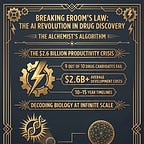

A molecule is designed. A target is selected. A lab experiment is run.
Most candidates fail.
In this episode, I break down why AI drug discovery is not merely another speculative biotech buzzword cycle.
It is a structural attempt to compress the most expensive search problem in science: finding molecules that work inside living systems without poisoning them, disappearing too quickly, missing their target, or detonating in the body like a tiny financial derivative from hell.
The core argument is this:
The bottleneck in drug discovery is not just intelligence. It is search capacity.
Human researchers are brilliant. But chemical space is effectively infinite. Protein biology is dynamic, messy, probabilistic, and often brutally unforgiving. AI does not need to be “smarter” than scientists to be useful. It only needs to search, simulate, predict, and iterate faster than human teams can.
That is already beginning to happen.
The Crisis: Drug Discovery Has Become a Productivity Trap
The pharmaceutical industry has delivered extraordinary medicines. But its underlying R&D machine has grown slower, more expensive, and more failure-prone over time.
The old model looked roughly like this:
Identify a biological target.
Design or screen compounds.
Test them in cells and animals.
Push the best candidates into humans.
Watch most of them fail.
The brutal part is that many failures occur late, after enormous amounts of capital have already been committed.
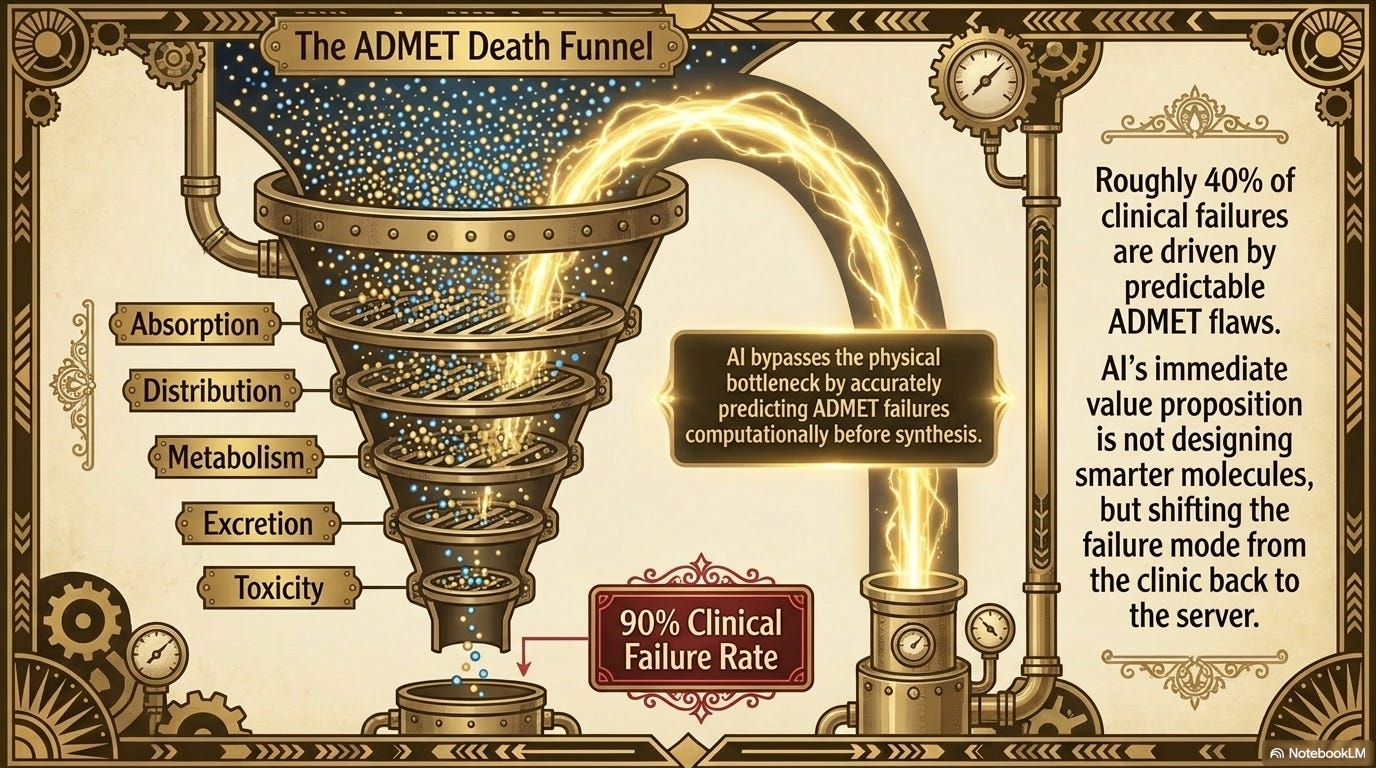
A drug may look promising in a petri dish and still fail because it cannot be absorbed properly, does not distribute to the right tissue, gets metabolized too quickly, cannot be excreted safely, or proves toxic in humans.
That bottleneck is called ADMET:
Absorption. Distribution. Metabolism. Excretion. Toxicity.
In plainer English: Can this thing actually become a medicine, or is it just a beautiful molecule with a death wish?
This is where AI has its first major opening. Not by magically inventing perfect drugs, but by moving failure earlier in the process — from the clinic back to the server.
A failed molecule in a model is cheap.
A failed molecule in Phase II is a smoking crater.
The AlphaFold Moment: Biology Gets Its Map
One of the most important breakthroughs behind the current AI drug discovery wave was AlphaFold.
For decades, scientists knew that a protein’s function is determined by its three-dimensional structure. But solving those structures experimentally was slow, expensive, and technically difficult.
The Protein Data Bank accumulated roughly 170,000 experimentally determined protein structures over about 50 years.
Then AlphaFold and related systems changed the scale of the problem almost overnight. The field moved from hundreds of thousands of experimentally resolved structures to hundreds of millions of predicted structures.
That is not a small improvement.
That is like going from a candlelit map of a village to satellite imagery of a continent.
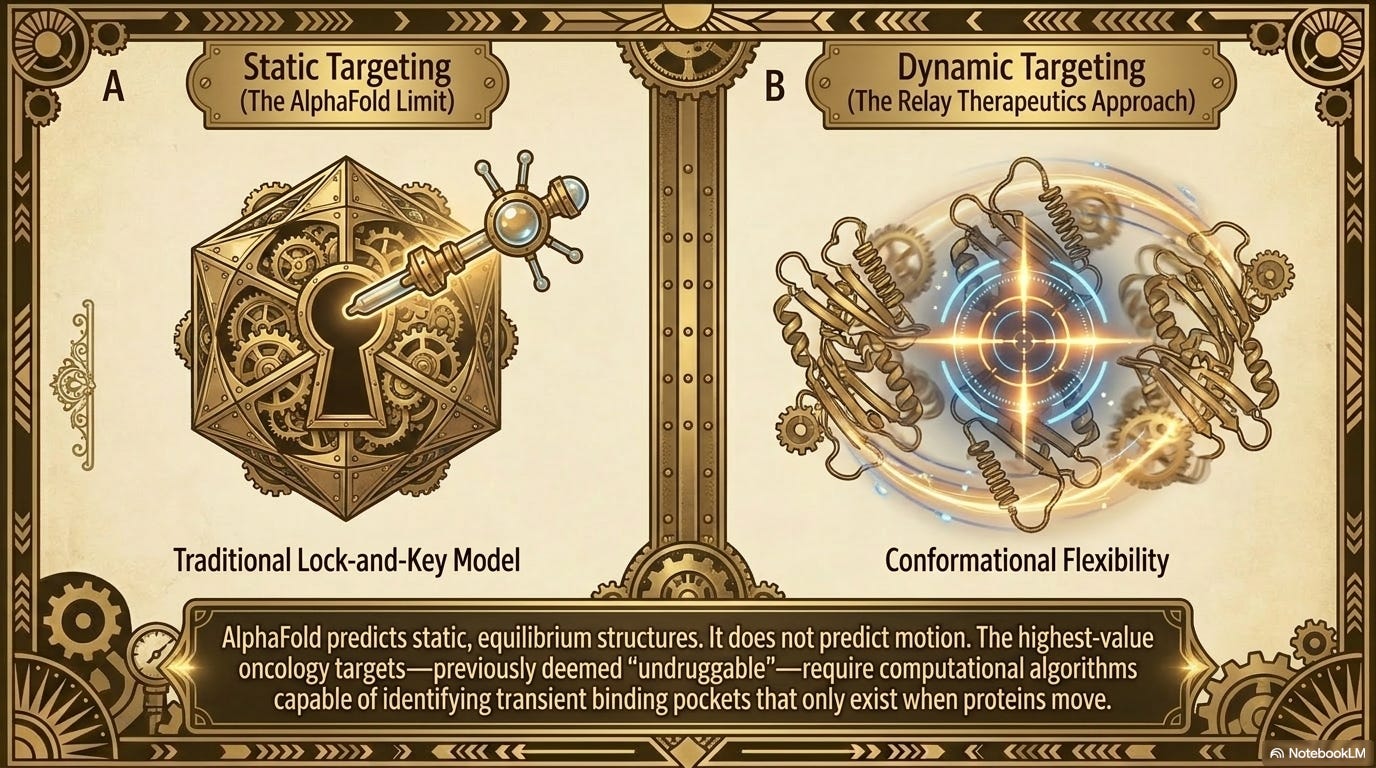
But this matters because structure-based drug design depends on knowing the shape of the target. If you do not know the lock, designing the key becomes mostly guesswork. AlphaFold did not solve drug discovery by itself, but it removed one of the most important walls in the room.
The remaining walls are still formidable: dynamic protein motion, ligand binding, toxicity, patient heterogeneity, clinical trial design, and regulatory validation.
But the room is no longer dark.
The Real Investment Question
The investment story is not simply, “AI will discover drugs, therefore buy anything with AI and biotech in the pitch deck.”
That is how money goes to heaven wearing clown shoes.
The better question is:
Which companies are building durable data flywheels, validated platforms, and partnership structures that can survive biotech’s natural violence?
The companies worth watching fall into several buckets:
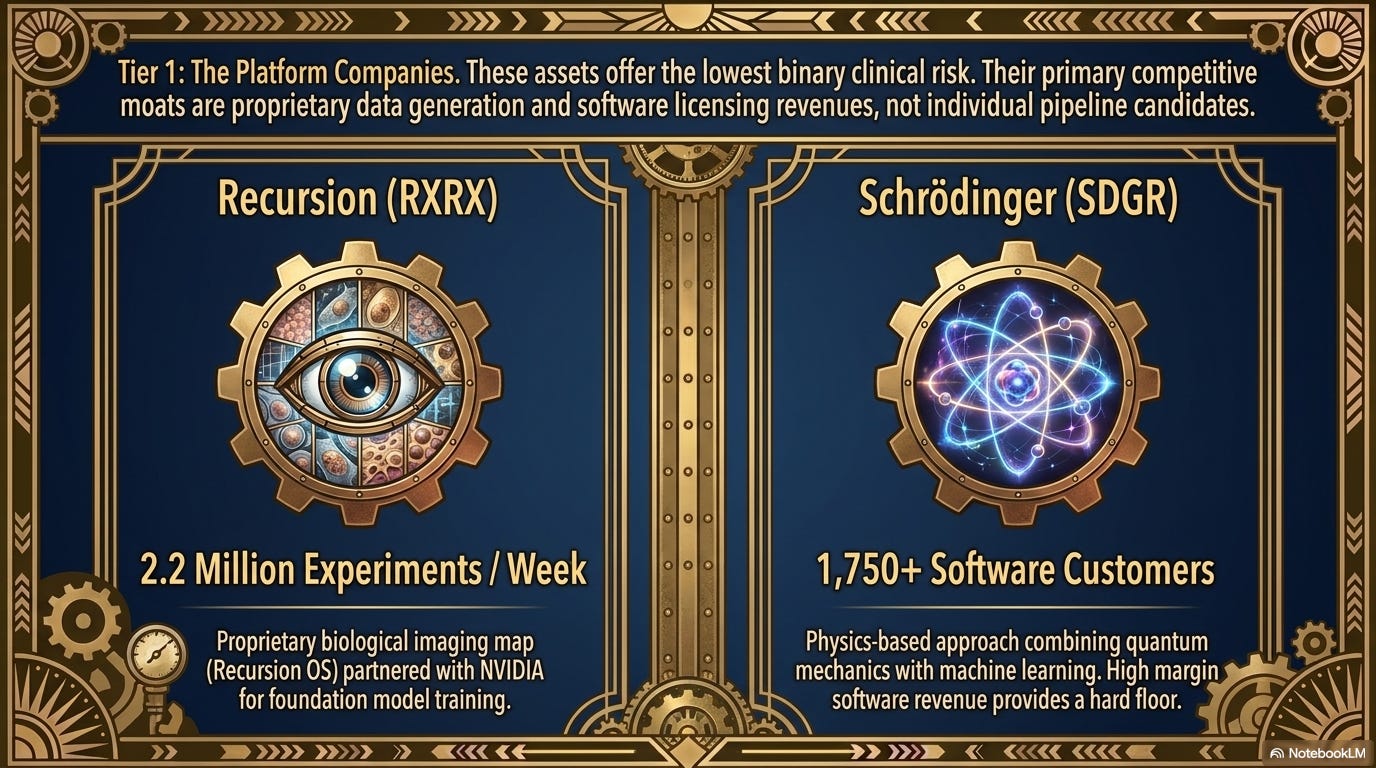
Platform companies such as Recursion and Schrödinger, where the value may come as much from proprietary data, software revenue, and workflow ownership as from any one drug candidate.
Clinical-stage pure plays such as Exscientia, Relay Therapeutics, Absci, and Insilico Medicine, where the upside may be enormous but the risk is more binary.
Strategic private players such as Isomorphic Labs, the Google DeepMind spinout, which may become one of the defining AI-biotech IPO stories if and when it reaches public markets.
The distinction matters.
A company with one AI-designed drug in trials is still exposed to classic biotech risk. A company with a defensible platform, recurring software revenue, proprietary biological data, and multiple shots on goal has a different profile entirely.
In this space, the phrase “AI drug discovery company” is almost too broad to be useful.
Some are software companies wearing lab coats.
Some are biotech companies wearing transformer goggles.
Some are PowerPoint companies wearing venture capital cologne.
Sorting them is the whole game.
Where AI Has the Best Shot First
AI drug discovery will not advance evenly across medicine.
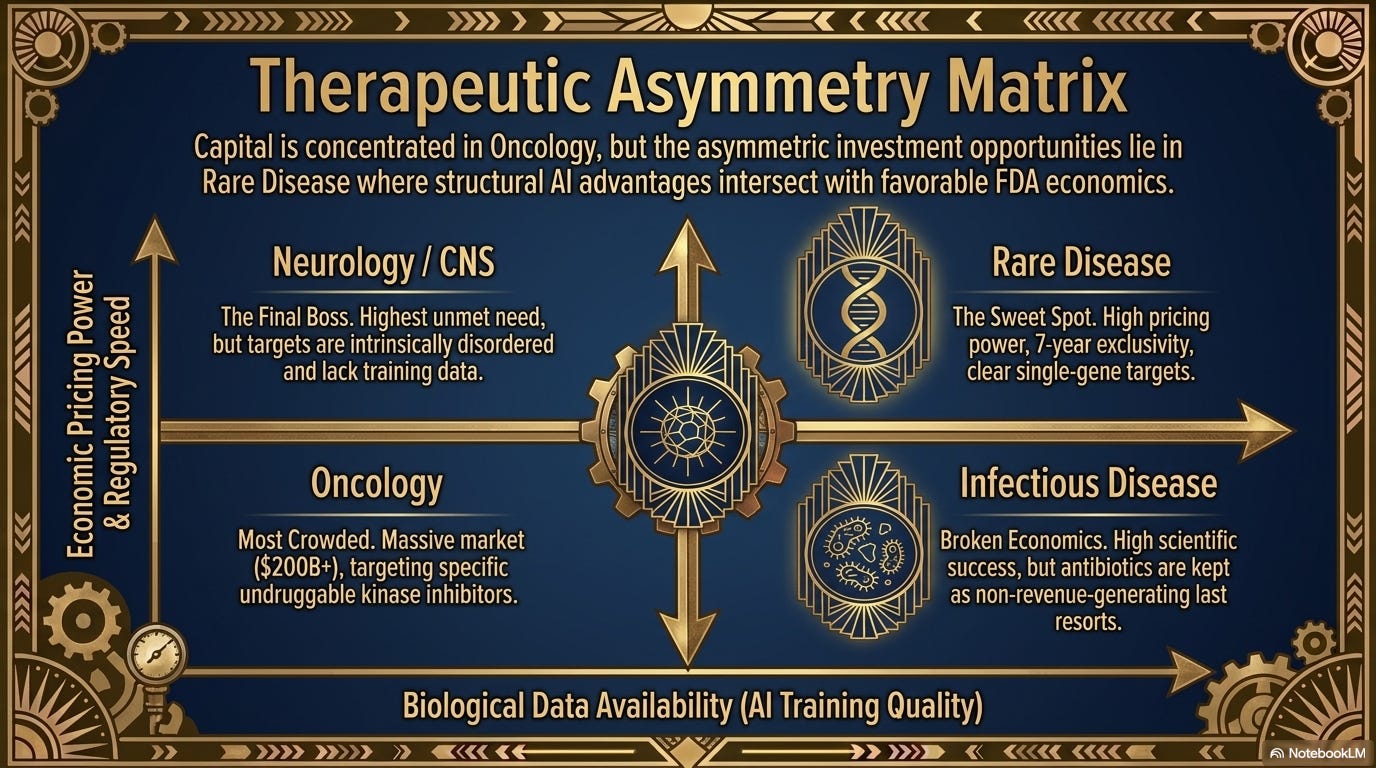
The highest-probability early wins are likely in areas where the biology is relatively well-defined, the targets are structurally tractable, and the regulatory economics are favorable.
That points toward:
Rare disease, where single-gene mechanisms often make the target clearer and orphan-drug economics can improve the return profile.
Oncology sub-niches, especially previously “undruggable” targets where computational design can identify binding pockets or dynamic conformations that traditional methods missed.
Antibody and biologics design, where AI can accelerate the design-test-learn loop.
The hardest prize is probably neurology.
Central nervous system drug discovery has one of the highest failure rates in medicine. The blood-brain barrier is a fortress. Many targets are intrinsically disordered proteins. The training data is thinner. The biology is stranger. The unmet need is enormous, but the mountain is steep.
The company that cracks neurodegeneration with AI will not just create a successful biotech platform.
It may rewrite the emotional economy of aging.
The Regulatory Bottleneck
The FDA is not rejecting AI. But regulators are not going to wave through black-box molecules because a model said they looked promising.
That is a fantasy.
The regulatory question is not whether AI can be used. It is whether the process can be explained, validated, documented, and tied to biological rationale.
Regulators will want to know:
What data trained the model?
Was the data biased or incomplete?
Can the prediction be experimentally validated?
Does the model’s output make scientific sense?
Can the company explain why the molecule should work?
In other words, the future belongs not to autonomous black-box drug factories, but to companies that can combine AI prediction with human-guided, experimentally validated, physics-aware workflows.
The machine may suggest the path.
The lab still has to walk it.
The Core Thesis
AI drug discovery is not hype in the empty sense.
The hype is real, but the underlying shift is also real.
That is the uncomfortable part.
This is one of those sectors where both things can be true at once:
The technology is transformational.
Many of the companies will fail.
The first proof-of-concept approvals could reprice the entire sector.
The timeline will probably be longer than the most excited investors expect.
The winners may be worth far more than today’s market currently understands.
The key is not believing every claim.
The key is knowing what to measure.
In my view, the strongest signals are:
Proprietary biological data at scale.
Multiple validated partnerships with real upfront capital.
Clinical programs that demonstrate compressed discovery timelines.
Regulatory explainability.
Cash runway discipline.
Platform economics, not just single-asset speculation.
The alchemists wanted to turn lead into gold.
AI drug discovery is trying to do something stranger and maybe more valuable:
turn biological uncertainty into searchable probability.
That does not eliminate risk.
But it changes the shape of it.
The first generation of modern pharma found magic bullets by searching nature.
The next generation may find them by searching probability space.
But this is not a story about replacing science with software. It is a story about giving scientists better instruments — telescopes for molecules, radar for toxicity, maps for proteins, and maybe eventually a compass for the biology we still barely understand.
The alchemists had the right dream.
They were just missing the algorithm.


